• Skip to primary navigation
  • Skip to main content
newberkshire.com logo

newberkshire.com

  • Bob Dylan matters
  • Contact us
  • Home

Dave Read

Bob Dylan’s Rolling Thunder Revue party at Mama Frasca’s Dream Away Lodge

Sept. 1998 interview by Dave Read

On November 7, 1975, Bob Dylan and the Rolling Thunder Revue spent the day at the Mama Frasca’s Dream Away Lodge in Becket, MA. They had played two shows the day before at the Springfield Civic Center, with special guest and Berkshire county resident Arlo Guthrie, who turned Dylan on to his friend Mama Frasca’s lodge. (See related: Interview with Arlo Guthrie)

This interview is the account of a friend of Mama Frasca’s who asked us to refer to him as “A.I.I.” (Anonymous Indigeneous Individual). It was conducted by Dave Conlin Read in Lenox, MA in 1998 and was excerpted in Q magazine’s special edition Maximum Bob.

Rolling Thunder Revue tour poster

D.C.R.: How did you come to be involved with MamaFrasca’s Dream Away Lodge?

A.I.I.: Just a Berkshire hillbilly, I was living up there on Becket mountain, and I used to visit the Lodge. It was my social milieu. And I used to help Mama Frasca; she was basically illiterate, and I used to write alot of postcards for her. I’d be sitting with her in the afternoon or evening and she’d tell me what she wanted to tell her friends. We were just good pals, myself and Mama.

(Sample photos from the party: Rolling Thunder: Photographs by Ken Regan. )

D.C.R.: You were invited to the Rolling Thunder Revue party?

A.I.I.: Yes, I was up there when there was a phone call and Mama got very excited. She kept saying, “Joan Baez is coming, Joan Baez is coming.” She didn’t say much about Bob Dylan. So, I was invited to the party the next day. I went up there early in the day, around noontime. A couple of guys from Shenandoah came up there shortly. Arlo Guthrie came up in his Ford pickup, I think it was a ’51 Ford – faded green pickup, maybe it was gray. I remember watching the hawks circling with one of the guys from Shenandoah, on the front steps of the Dreamaway.

And then, after a while, various people started arriving. I remember Dylan coming up in a Winnabago. He had a little sign in one of the side windows, it said “Kemp Fish Co.” I remember the cinematographers coming up in a big red Cadillac convertible. Then I was inside having a beer at the bar, and I guess Bob was having a brandy and talking with Mama. I remember introducing Bob to my friend Bob, saying “Bob, meet Bob”.

When Joan Baez got there, Mama swooped her right upstairs. Joan came in in dungarees, all denim. She went upstairs like that – she came down in a white dress with a white pearl necklass. She went right into the music room and Mama took her over to the big square piano. I think she sang – what’s that song – with a wretch like me? – she sang “Amazing Grace.”

Alot of people started crowding into the music room, and the photographers, the cinematographers, started taking alot of shots of Joan and Mama at the piano. Mama was coming out with these mountain-oracle words-of-wisdom and wit and everybody was sucking it up. Because that was about what she was – she was the Oracle.

Earlier, I remember Dylan leaning over the bar to listen to her – to one thing that she said to Dylan, and he was just hanging on every word she said. She had this big thing about love – “With love you’re like the egg – without love, you’re like the hollow egg, without yolk, all white”. Something like that, she had a way of saying things, you had to be there to hear her.

She was quite a character. She had a little guitar, it was painted lime-green, and she used to like to play when she sat in front of the fireplace. She used to call everybody children or sonny – she’d make you feel like you were a child and she was the adult.

They served the standard dinner – salad, chicken, spaghetti, and Mama’s famous hot potatoes, and coffee and Anisette after. Ginsberg was walkin around with Moby Dick, reading it, reading Moby Dick as he was walking around, because he knew of Melville’s stay in the Berkshires, writing Moby Dick in Pittsfield. And then Dylan was going in and out the window, of the freshly-painted north side of the Dreamaway.

D.C.R.: How did you know it was freshly-painted?

A.I.I.: Because my friend was painting it, who I had introduced to Bob – “Bob, this is Bob”, because Bob lived there. He was the caretaker of the place – the bartender, the dishwasher, and everything else. So the next day Bob, the other Bob, made a little sign that said, “Bob Dylan’s footprints”, with an arrow going to the window where he had been climbing in and out – to get away; to get a breath of fresh air from the packed place.

D.C.R.: How many times did Bob go in and out of the window?

A.I.I.: It was just a little prank – he may have done it only once. But I remeber we had the footprints, and they were there for a while, until it got painted again. I remember singing “Be bop a lula” at the piano – Arlo playing the piano.

Singing that song with Bob and Ramblin’ Jack Elliott and the whole crew there. We all did a good rendition of “Be bop a lula.” I remember Joan seemed like a very genuine, sincere individual, interested in the people at large there – the natives. She just seemed genuinely friendly – just a regular person.

D.C.R.: Did Bob take the initiative with any of the music, did he take the lead?

A.I.I.: Not to my recollection. He was belting out the “Be bop a lula” lyrics, I was right there beside him, singing – he was getting into that. His wife was there, Sara, and she and Ginsberg seemed to be talking quite a bit, I don’t know how much weight that had. And Ronee Blakely was there. I had a nice conversation with her, down by the fish pond, feeding the catfish. They used to eat bread out of your hand. It was kind of like feeding piranas, because they’d all come to the surface as soon as you’d throw a little piece of bread in there – they would swarm around. That was another little gig that Mama had there for people – “Oh go down and feed the fish, here take some bread and feed the fish.”

D.C.R.: How did the party break up?

A.I.I.: I didn’t stay into the night time, I kind of drifted away, went home. I left before Bob and the crew. It was like a poetic moment – a happening – it was living poetry, very memorable.

D.C.R.: How did Mama feel about the party afterwards?

A.I.I.: Well Mama loved all kinds of people, but for some reason, she had a real affinity with Joan Baez. She really loved Joan Baez’ voice, essentially. She thought she had a wonderful, beautiful voice, and that it was a gift. So she was just very, very happy to be Joan Baez’ hostess that day.

Arlo Guthrie interviewed Nov. 1998 at The Guthrie Center

Nov. 16, 1998 interview by Dave Read.
Arlo Guthrie first came to the Berkshires in the late ’50s to attend the former Indian Hill camp in Strockbridge, where his mother was the dance teacher. His Berkshire roots were further established while he was a student at The Stockbridge School and he became involved with the Berkshire Folk Music Society, then headed by the late Hank Grover, David’s father.

Guthrie recently bought the Kresge Building on North St. in Pittsfield. Besides moving Rising Son Records there, he is looking into the possibility of developing an entertainment center. We visited with Arlo on November 16, 1998 at The Guthrie Center, in the former Episcopal church that his friend Alice Brock used to live in, and where much of Alice’s Restaurant was filmed.

Arlo Guthrie interview with Dave Conlin Read at the Guthrie Center, Nov. 1998.

“I’ve been trying to get something going in downtown Pittsfield for 25 years. I was interested in the old Palace Theater, or even the Capitol before they turned it into the Senior Center. None of that ever panned out because nobody had a clue as to the value of live entertainment.”

Relating the results of a recent study, commissioned by the city of Pittsfield, that stresses how important providing live entertainment is to the revitalization of downtown, Guthrie continued,

“We want to see if we can be a part of that process. We bought the building and we’re hoping that we can make a go of it. I want to develop a nightclub facility, maybe with a little food, but not a big-time restaurant. What I really know is not the restaurant business, it’s the nightclub/theater business.”

Arlo Guthrie photo proofs

After talking about the various “cultural centers” and “tourist destinations” of Berkshires, Arlo continued,

“I see no reason why Pittsfield can’t become a part of all that, even add something to it and tie together all the different crowds. This is a beautiful part of the world, every part of it. We’ve been let down by the major industries. The only big industry that keeps growing is our cultural industry, so I’m anxious to see if we can all benefit from that.”

The legacy of The Music Inn figures prominently in Guthrie’s motivation to extend his commitment to the Berkshires. His father Woody played the very first show there and Arlo played the last, exactly 25 years to the day later.

“The thing we do in Pittsfield will be the closest that we can get to re-doing the kind of music that we had at The Music Inn. It’ll be a big enough club to bring in some of the same kinds of people – maybe the same people. With the help of the City of Pittsfield, I think we can make that happen. We also want a place for young people to go; we’re thinking of establishing a kind of folklore center there.”

“It’s not something I have to do business-wise; I’ve got enough going on to keep me busy for a long time. However, one of the things I’d like to do is spend less time on the road. I’m on the road ten months a year, and I miss the Berkshires. I love it here and I think that we have an obligation to try and retain the best part of who we are for future generations.”

Where did the name “Arlo” come from?

“When my mom was growing up, there was a series of children’s books, called “Arlo Books”, about a little Swiss kid named ‘Arlo’. They were in all the primary schools on the East coast, and she drew a picture for a class project of this kid. And my mom was one of these packrats who saved everything – every ticket stub of every place she had ever been to. She was incredibly organized.

“While she was pregnant with me, walking down the beach one day with my dad, she suddenly realized that the picture she had drawn of this kid ‘Arlo’, in the fifth or sixth grade, looked exactly like my father. He was wearing the same clothes, the same kind of striped shirt, walking on the same kind of beach. And so she went back and found this old picture, and sure enough, she had drawn my dad.

“So they decided that that was an auspicious sign, and that they were going to name me after the kid. But they didn’t know if I would go for a name as awkward as that, so they gave me the middle name ‘Davy’. So I was named after Davy Crockett. She figured he was a popular figure, sort of a rugged, mountain guy, and if I didn’t like the name ‘Arlo’ – which, she wasn’t sure what that was gonna do to me – that I could always call myself ‘Davy’. So I was named ‘Arlo Davy Guthrie.’

Mama Frasca’s Dream Away Lodge

“I had been going to the Dream Away for years, I knew Mama Frasca real well – she was a terriffic, wonderful, crazy, wild woman. I really loved her and used to bring the kids up to her place every weekend. I actually did some recording with her at the old Shaggy Dog studio in Stockbridge. We did a great record there – all these great songs with this old gal. She made a single, and one song was called something like, “God and Mama”.

“So after we did the Rolling Thunder Revue in Springfield (November 6, 1975), I tought it would be fun to take everybody up there. We came up with Bob Dylan, Joan Baez, Allen Ginsberg, Bobby Neuwirth and Ramblin Jack Elliott. They just loved it there; we were fooling around with Mama Frasca, and it became a part of the film, “Renaldo And Clara”.

(For details of the party: Bob Dylan’s Rolling Thunder Revue party at Mama Frasca’s Dream Away Lodge.)

Bob Dylan concert review – Wahconah Park, Pittsfield, MA June 23, 2005

June 23, 2005 concert review by Dave Read

The setlist for Bob Dylan’s June 23 concert in Pittsfield’s worn green wooden Wahconah Park (built in 1919) was old, with 9 songs from 1967 and earlier, and the playing was more jazz blues than blues rock, reflecting the presence of newcomers Denny Freeman (guitar) and Donny Herron (steel guitars, banjo, fiddle, mandolin), who joined Dylan’s band in March 2005.

Together with lead guitarist Stu Kimball (joined June 2004), their leads and solos, rooted in a raft of genres, provided apt accompaniment to Mr. Dylan, whose singing was strong and varied, whose keyboard playing was high in the mix, and whose center stage harmonica solos included some that made him resemble a wooing suitor.

Knowing Bob Dylan’s lyrics is not a requirement to enjoying his shows, but it’ll give you a leg up. The best way to learn them is to listen to the albums. You’re not going to learn them at the shows, where they take on an extra-literal dimension, with Dylan often treating lines of lyric as if they were strings on a guitar.

A big, broad rendition of “Drifter’s Escape” (John Wesley Harding ’67) that gave everybody in the band time to get limber was the opener, followed by “Just Like Tom Thumb’s Blues,” which had the band laying low while Dylan sang, intoned, and crooned the beatnik-crazy lyric all the way down to the penultimate stanza,

“Now all the authorities
They just stand around and boast
How they blackmailed the sergeant-at-arms
Into leaving his post
And picking up Angel who
Just arrived here from the coast
Who looked so fine at first
But left looking just like a ghost”

after which Herron let loose a wailing steel guitar riff that sent the band off on a rollicking ride that Dylan finally whistled to a stop with a center stage bended-knee harmonica coda.

That was the first of three songs from Highway 61 Revisited (August 1965) and the next on this setlist comes from Bringing It All Back Home (April, 1965), a rendition of “It’s All Right, Ma (I’m Only Bleeding)” that was worth the price of admission all by itself. While the band took their stellar turns weaving the melody and waxing the groove, Dylan kept his focus square on the audience, leaning over the keyboard to deliver the song that contains the line that always gets a loud response, “But even the president of the United States/Sometimes must have/To stand naked.”

Bass player and musical director Tony Garnier and drummer George Recile underpin the whole operation with masterly playing, adding accents, embellishment, and punctuation in all the right spots. Garnier, a fellow Minnisotan, has been on Dylan’s Never-Ending Tour since its second year, 1989; Recile, from New Orleans, has been Dylan’s drummer since 2001 (which frequently, but not tonight, requires being the object of Dylan’s silly dumb-drummer jokes).

An interesting bit of business at the Pittsfield concert was Garnier reaching up and slapping one of Recile’s cymbals, to signal the start of “Chimes of Freedom,” from the 1964 album Another Side of Bob Dylan, which, in a multi-layered acoustic rendition, was one of the show’s most affecting numbers.

What a piece of writing that song is! From the opening lines,

“Far between sundown’s finish an’ midnight’s broken toll
We ducked inside the doorway, thunder crashing…

to the closing verse,

“Tolling for the aching ones whose wounds cannot be nursed
For the countless confused, accused, misused, strung-out ones an’ worse.”

The first of 2 encores came from that album, too, “It Ain’t Me, Babe,” Dylan opening and closing it on harmonica. The Turtles had a huge hit with it in 1965, and the genius of Dylan the composer can be glimpsed by scanning the range of artists who have covered the song: Hugo Montenegro, Nancy Sinatra, Flatt & Scruggs, Sebastian Cabot, Glenn Campbell, The Mike Curb Congregation, Duane Eddy, and Johnny Cash, to name just a few!

The only song that didn’t seem to work this night was the set-closing “Summer Days,” (Love and Theft ’01) which sounded earnest but fatigued. The other 2 songs from Highway 61 Revisited were the title song, given a thundering reading an hour into the show and “Like A Rolling Stone,” the grand finale, the song so grand it has its own biography! (Like a Rolling Stone: Bob Dylan at the Crossroads, by Griel Marcus)

June 23, 2005 setlist: All song lyrics available on: bobdylan.com.

1. Drifter’s Escape (John Wesley Harding ’67)
2. Just Like Tom Thumb’s Blues (Highway 61 Revisited ’65)
3. It’s Alright, Ma (I’m Only Bleeding) (Bringing It All Back Home ’65)
4. Moonlight (Love and Theft ’01)
5. Down Along The Cove (John Wesley Harding ’67)
6. Girl Of The North Country (acoustic) (The Freewheelin Bob Dylan ’63)
7. High Water (For Charley Patton) (Love and Theft ’01)
8. Every Grain Of Sand (ShotOfLove ’81)
9. Highway 61 Revisited (Highway 61 Revisited ’65)
10. Blind Willie McTell (The Bootleg Series, Vols. 1-3 ’91(recorded ’83))
11. Chimes Of Freedom (Another Side of Bob Dylan ’64)
12. Summer Days (Love and Theft ’01)
(encore)
13. It Ain’t Me, Babe (Another Side of Bob Dylan ’64)
14. Like A Rolling Stone (Highway 61 Revisited ’65)

Leave a Comment

Bob Dylan concert review, Newport Folk Festival, Aug. 3, 2002

By Dave Read, Lenox, MA, Aug. 3, 2002

– With his highly anticipated return to the Newport Folk Festival, Bob Dylan presented his audience not with a musical masterpiece nor any acknowledgment that this was a special gig, but rather the silly sight of himself wearing a wig that could have been styled by ex-congressman Jim Traficant.

Was this an indication that Mr. Dylan has a new cause to champion, having found something redeeming about Traficant unseen by the public and the press? Or was it just a goof to see how much palaver the wig (and fake beard) will generate in the media and elsewhere, his Newport ’65 performance having established the gold standard for much ado about nothing much?

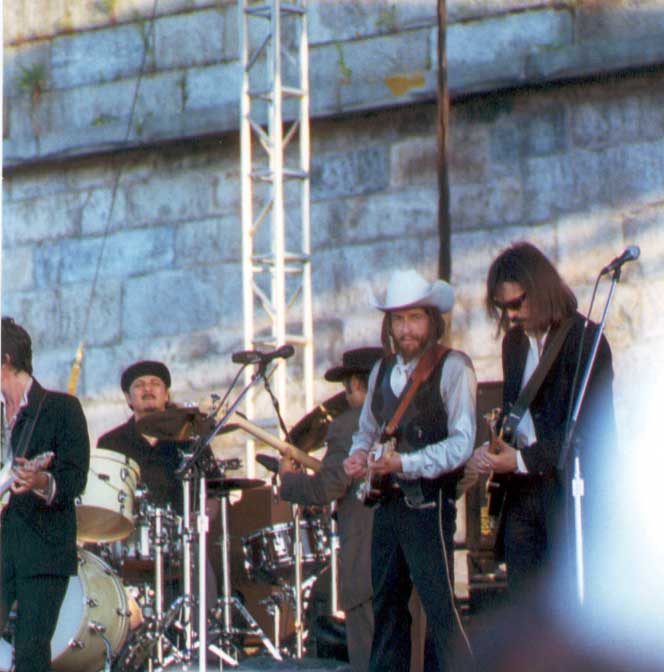
Bob Dylan at 2002 Newport Folk Festival concert review by Dave Conlin Read

The setlist itself was a highlight, including “Subterranean Homesick Blues,” “Desolation Row,” “Positively 4th Street,” and “The Wicked Messenger;” plus two of the five songs he played here in 1965, “Like A Rolling Stone” and “Mr. Tambourine Man.” Anyone looking for special significance could sift through those lyrics, playful, querulous, and redolent as they are, cut and paste a bit, and posit “Dylan’s nod to Newport.”

The Newport ’65 story percolated along through the decades without Dylan’s input, got a big boost after the recent death of Alan Lomax, and culminated Saturday on the op-ed page of the New York Times with a piece by festival founder George Wein. Our 2 cents worth: If Mr. Lomax and Pete Seeger had been more polite and composed that day, we probably would have been spared the hysterical story that wouldn’t die.

So unless there’s some significance to the applied hair, for Dylan it was just another gig on his “never-ending tour,” rather than his triumphal return to the Newport Folk Festival.

Indeed, his seemed to be an extra-festival set, as before he came onstage the Apple and Eve Newport Fok Festival backdrop was removed and the press area near the stage was evacuated.

Today’s was a typically generous 2 hour show of 19 songs, the second gig after a 12 week touring hiatus, which left an overall impression of being under-rehearsed. It lacked the seamless brilliance of last November’s tour finale in Boston, which was a masterpiece.

Bob Dylan at 2002 Newport Folk Festival; Dave Read photo

That his setlists are built around songs written decades ago is testament to the fact that what Dylan created then is as fresh and welcome today as a sea breeze. But over the past several years, he has displayed a genius for performance, adding to his own incomparable song catalogue the works of other artists, blending the old and the new, his songs and others,’ cool costumes, crazy choreography, grimaces and grins, to present concerts that amount to fresh pieces of art.

Today, however, there were only artful segments, such as the electric, rollicking “Summer Days,” which followed the acoustic “Mr. Tambourine Man.” On the latter, Dylan’s delivery seemed narrational, which may have seemed apt to him as his audience at that moment actually was “…Silhouetted by the sea” and if not exactly “…circled by the circus sands,” then surely circled by the carnival tents of falafel and t-shirt vendors.

After a swig of water and strapping on his Stratocaster, Dylan then cut loose on a searing rendition of “Summer Days,” nodding his head and looking quizzically at his flanking guitar mates, Charlie Sexton and Larry Campbell. This is an infectiously swinging tune, with a wild pastiche of lyrics, including an excerpt from The Great Gatsby, “She says, “You can’t repeat the past.” I say, “You can’t? What do you mean, you can’t? Of course you can.””

Bob Dylan at 2002 Newport Folk Festival concert review by Dave Conlin Read

Bob Dylan has never seemed interested in repeating the past; and it doesn’t seem likely there’ll be a repeat of all the Newport ’65 malarkey in the wake of Dylan Newport ’02. One thing for certain about it: there were no boos, but there were plenty of fruit juice.

Setlist (thanks to Bill Pagel at BobLinks):

1. Roving Gambler (acoustic)
2. The Times They Are A-Changin’ (acoustic) (Larry on cittern)
3. Desolation Row (acoustic)
4. Mama, You Been On My Mind (acoustic) (Bob on harp)
5. Down In The Flood
6. Positively 4th Street
7. Subterranean Homesick Blues (Larry on slide guitar)
8. Cry A While (Larry on slide guitar)
9. Girl Of The North Country (acoustic) (Bob on harp)
10. Tangled Up In Blue (acoustic) (Bob on harp)
11. Mr. Tambourine Man (acoustic)
12. Summer Days (Tony on standup bass)
13. You Ain’t Goin’ Nowhere (Larry on pedal steel)
14. The Wicked Messenger (Bob on harp)
15. Leopard-Skin Pill-Box Hat

(encore)
16. Not Fade Away
17. Like A Rolling Stone
18. Blowin’ In The Wind (acoustic)
19. All Along The Watchtower

the now-obsolete Trafficant reference

From Representative Traficant’s final speech in the House of Representatives. Shortly after this speech, the House voted 420 to 1 to expel Traficant. Congressional Record, 24 July 2002, pages H5385–H5392.

“Am I different? Yeah. Have I changed my pants? No. Deep down my colleagues know they want to wear wider bottoms; they are just not secure enough to do it. I do wear skinny ties. Yeah, wide ties make me look heavier than I am and I am heavy enough.

Do I do my hair with a weed whacker? I admit.” ^ return top.

As of 9 Aug. 2022 – this show is available on Youtube:

Leave a Comment

Bob Dylan concert review – Boston, Nov. 24, 2001

Nov. 24, 2001 concert review by Dave Read – Decked out in a sparkling white suit, 10 weeks after 9/11, Bob Dylan took the stage of Boston’s Fleet Center at 8:15 on the Saturday after Thanksgiving, bounding up to the mic on the balls of his feet, and laid into Hank Williams’ Wait For the light to Shine, beginning a 2½ hour concert that closed the first “Love and Theft” leg of his never-ending tour.

Including six songs from the already-gold “Love and Theft” mixed in with “standards” that are older than many of the 14,000+ in attendance, it was a memorable performance – displaying many facets of Dylan’s genius: poet, composer, guitar slinger, talent scout, vocalist, and nimble-footed knee-waggler.

The opener had a playful feel to it and was followed by It Ain’t Me, Babe, begun a capella and then laid against the quiet sound of acoustic guitars and bass with rhythmic highlights from drummer David Kemper’s brushwork. Dylan delivered the verses without much variation, saving his emphasis for the refrains.

Coming to the end of the lyric, he fairly barked out a “babe” full of derision, but then repeated the last lines in a melodious fashion, tip-toed backwards to get his harmonica and light-footed it back to the mic where he delivered a coda almost on bended knee.

Next, on A Hard Rain’s A-Gonna Fall, the band provided an expansive musical meadow, flowered by Larry Campbell’s bouzouki, for Dylan to romp through giving voice to this lyric that is remarkable for so many reasons, not the least of which is that he wrote it when he was barely out of his teens.

The replies to “Oh, where have you been…?, Oh, what did you see…?, Oh, what did you hear…?, Oh, who did you meet…?,” were variously recited, chanted, and intoned. The song’s final question, “Oh, what’ll you do now…?” was answered in exhortation, Dylan adding a syllable-full of angst at the end – “yea-as, it’s a hard rain’s a-gonna fall.”

Another cover song, the plaintive Searching for a Soldier’s Grave, featuring vocal harmonies and Campbell’s mandolin playing, was followed by the first song from “Love and Theft,” Tweedle Dee & Tweedle Dum, a hugely fun rollicking tune jammed full of little aural treats.

The band was back-lighted on this number and the lighting played a role on the next tune, too, helping to show that the essence of Just Like a Woman, which has no trouble standing alone on the printed page as an integral work of art, lays in just a few simple notes, which convey effortlessly all the bittersweet emotion that is spelled out in the lyric.

Focusing on the dozen or so notes of the jaunty, descending melodic hook (which follows “…But you break just like a little girl” on the original recording) – the stage lights went down while Dylan repeated the melody a few times, then back up for another run through, now augmented by Campbell’s pedal steel guitar.

It was on this number, too, that Dylan threw all his dance moves into the performance. Almost always facing the audience, he’d move up to and away from the mic, using little hopping steps on the balls of his feet – like he didn’t want his footsteps to be heard. Was he being furtive? Coming like a thief in the night?

Having the new Lonesome Day Blues follow that newly-revealed old chestnut was felicitous; it is straight forward and all-of-a-piece, driven by a hypnotic rhythm overlaid with some nifty guitar-slinging. The sound is very heavy and the lyric, which appears to be linear, contains this perplexing juxtaposition:

“Well, I’m forty miles from the mill I’m dropping it into overdrive,
I’m forty miles from the mill I’m dropping it into overdrive,
Set my dial on the radio I wish my mother was still alive.

I seen ya loverman coming, coming across the barren fields,
I see ya loverman coming, coming across the barren fields,
He’s not a gentleman at all, he’s rotten to the core, he’s a coward and he steals.”

Also new, Highwater (for Charley Patton) came next, begun with Dylan racing through the opening lines before the band joined in, led by Campbell on banjo. The music built up and around the lyric, which is full of direct references and a variety of allusions. The performance had something of a tribal feeling to it, and the ad hoc Fleet Center tribe responded with big hand-thunder.

Next, it was back into acoustic mode for Don’t Think Twice, It’s All Right, another gem mined decades ago, back during the Kennedy administration, three years before Bobby Orr became the darling of all Bostonians, and two years before the folk mafia wigged-out down the highway at the Newport Folk Festival. (review of Bob Dylan at Newport, August 3, 2002)

Appearing like a youngster on stage tonight, like he’s having way more fun than anybody else in town, just how could Dylan have been so old so long ago that he knew so well how to handle heartbreak? Or did he just know how to write about it – writing a prescription and dosing himself with each performance?

To expand the medicinal metaphor, Don’t Think Twice, It’s All Right, offers physical therapy too, by way of finger-picking, and Dylan, Campbell, and Charlie Sexton all cut loose for quite a display of acoustic wizardry, continuing to pluck away for a couple minutes after the song’s closing lines.

Next was John Brown from the MTV Unplugged record, with Campbell on bouzouki again, followed by a spirited acoustic Tangled Up in Blue, with royal red lights flooding the arena, then two more new songs, the jook-joint feeling Summer Days with Tony Garnier spinning his upright bass and then the lugubrious Sugar Baby. And before the set-ending Rainy Day Women #12 & 35, they played a southern-rock styled The Wicked Messenger, which Dylan wrapped up with a little harmonica riff.

Like a Rolling Stone came after Things Have Changed, and tonight’s performance was another sweet-hot rocker that flowed freely, dis-encumbered of the barnacles of a thousand trips. That party piece was followed by the psalm, Forever Young, tonight given a transcendent reading with beautiful vocal harmonies, and then the new Honest With Me, featuring Campbell’s slide guitar licks, a song that would’ve fit nicely on the 1965 album “Highway 61 Revisited.”

Then, after a disguised introduction, Blowin’ in the Wind got a spirited playing with the band adding vocal harmonies on the refrain. Dylan and his band plugged in again for All Along the Watchtower, invoking the spirit of Jimi Hendrix with plenty of stellar guitar riffs and runs. Roy Orbison was brought to mind too, when Dylan mimiced his Pretty Woman growl on the penultimate line “Outside in the distance a wildcat did growl…”

Before the stage went dark again, Dylan held his guitar up in front of his face and bowed slightly. A moment later, over the din in the dark arena, we heard the band humming the chorus of Knockin’ on Heaven’s Door, followed soon by the cleanly enunciated: “Mama, take this badge off of me/ I can’t use it anymore./It’s gettin’ dark, too dark for me to see/I feel like I’m knockin’ on heaven’s door.”

And so, on the Saturday after Thanksgiving 2001, good ole’ Bob Dylan came to the Hub of the universe, acting like he’d copped more than just a moniker from >Dylan Thomas, who wrote this Note to his “Collected Poems”:

“These poems, with all their crudities, doubts, and confusions, are written for the love of Man and in praise of God, and I’d be a damn’ fool if they weren’t.”

1. Wait For The Light To Shine (acoustic) (Larry on mandolin) (song by Fred Rose)
2. It Ain’t Me, Babe (acoustic) (Bob on harp)
3. A Hard Rain’s A-Gonna Fall (acoustic) (Larry on bouzouki)
4. Searching For A Soldier’s Grave (acoustic) (Larry on mandolin)
(song by Johnnie Wright, Jim Anglin and Jack Anglin)
5. Tweedle Dee & Tweedle Dum
6. Just Like A Woman (Larry on pedal steel)
7. Lonesome Day Blues
8. High Water (For Charley Patton) (Larry on banjo)
9. Don’t Think Twice, It’s All Right (acoustic)
10. John Brown (acoustic) (Larry on bouzouki)
11. Tangled Up In Blue (acoustic)
12. Summer Days (Tony on standup bass)
13. Sugar Baby (Tony on standup bass)
14. The Wicked Messenger (Bob on harp)
15. Rainy Day Women #12 & 35 (Larry on steel guitar)

(encore)
16. Things Have Changed
17. Like A Rolling Stone
18. Forever Young (acoustic)
19. Honest With Me (Larry on slide guitar)
20. Blowin’ In The Wind (acoustic)
21. All Along The Watchtower
22. Knockin’ On Heaven’s Door (acoustic)

Setlist courtesy of Bill Pagel at BobLinks.com.

Leave a Comment

Bob Dylan concert review – Saratoga, NY Aug. 17, 2008

Aug. 17, 2008; concert review by Dave Conlin Read

Bob Dylan concert Aug. 17, 2008 at SPACDesolation Row, that crazy poem, is perhaps the most thoroughly satisfying song in all of Bob Dylan’s songbook. It was first released in 1965 on Highway 61 Revisted and that studio version seems to be a perfectly realized work of art. You’re hooked from the opening lines; Dylan’s quiet, clean guitar introducing a melody that within seconds has you expecting something, it feels ominous, and you are swept along by the ambling bass.

The sound is so compelling that you don’t notice how nutty the lyric is; rather the neatly-knit lines drown one’s sensibility with slug after slug of sensual imagery.

By the time we’re half-way through the song, by the fifth verse, not only have we been introduced to an improbable cast of characters, including:

  • the blind commissioner,
  • the tight-rope walker,
  • the riot squad,
  • Cinderella,
  • Romeo,
  • the hunchback of Notre Dame,
  • Cain,
  • Abel,
  • the Good Samaritan,
  • Ophelia,
  • Noah,
  • and Einstein,

but Dylan’s singing has become a mnemonic pattern buttressed by his own insistent guitar strumming that lopes along atop rumbling waves of bass notes, all accented by sweet little mandolin-sounding riffs that lurk just beneath the surface.

I am confident that if I awoke some day totally ignorant of the English language, I still could be amazed by the power and beauty of Desolation Row.

Most of the tricks in the poet’s bag are designed to get your attention; after all he has given you a piece of his art and left you alone to ponder it.

Bob Dylan is not limited to the poet’s bag. They’ve got onomotopaeia, synechtoche, rhyme, meter, and consonance, etc. Bob Dylan’s got all that PLUS a fantastic collection of fancy western hats and suits and a half-dozen musicians on retainer so that it seems natural for him to give a hundred shows a year where he presents fifteen or sixteen of his songs, some of which could stand alone on the page and have a poem’s way with you.

And if you’re a faithful fan, sometimes you get lucky and catch such a show as the one August 17, 2008 at Saratoga Performing Arts Center. Sometimes wildly lucky, like you’ve been singled out as a special beneficiary.

I’d been anticipating the trip to SPAC all the rainy Berkshires’ summer and that morning rifled through my collection to find the CD with a dozen versions of Desolation Row bootlegged by anonymous BobCats accross the decades. Couldn’t find it.

If memory were a better friend than it is, I could’ve retreived a few versions I’ve been present for: last June at Pines Theatre in Northampton, or the summer before at Wahconah Park in Pittsfield, or even 2002 at Newport.

Perhaps it was his cognizance of the fickleness of memory that impelled Bob Dylan to give the unforgettable Desolation Row the reading he did at Saratoga. It began familiar enough, in the fourth slot of a setlist that already contained a stunning rendition of It’s All Over Now, Baby Blue, another song from 1965 that hardly ever gets performed.

To digress just a bit, hearing … Baby Blue recalled the comment 2 hours earlier by Glen Hansard of the Swell Season who enthused about being on a bill with Bob Dylan, one of his personal Holy Trinity along with Leonard Cohen and Van Morrison. The connection is that one of my favorite Dylan covers is the one of Baby Blue done by Van Morrison and Them.

So Dylan and his superb band get in to a bright and lively Desolation Row, have the audience bobbing and weaving along, when, way before the time the door-knob broke, he suddenly morphs into a nursery school teacher and starts singing the song as clearly as he can in a melodic yet metronomic manner.

I got the feeling that, although there was affection for the audience, it was colored not a little by frustration that they’re not quite ready for the show.

The beautiful thing of it is that you can get an idea of how this version sounded by listening to the original studio cut. On it, each verse has two places where the lyric gets special emphasis, in the middle and at the end, where it changes from narrative to exhortation.

At this show, after following that pattern for the first five verses, Dylan goes for all exhortation (and also repeats a few couplets, intentionally or not).

This is his genius, to fashion fresh art on the spot, to the delight of old fans who now can feel more assured as well as to new ones, who would not think, to look at him, that he was famous long ago…

P.S. At SPAC, that was Donnie Herron playing electric mandolin (not violin)!

Setlist (thanks to Bill Pagel at BobLinks):

1. Leopard-Skin Pill-Box Hat (Bob on keyboard)
2. It’s All Over Now, Baby Blue (Bob on keyboard)
3. Rollin’ And Tumblin’ (Bob on keyboard, Donnie on electric mandolin)
4. Desolation Row (Bob on keyboard and harp, Donnie on electric mandolin)
5. Stuck Inside Of Mobile With The Memphis Blues Again (Bob on keyboard and harp)
6. Million Miles (Bob on keyboard and harp)
7. Most Likely You Go Your Way (And I’ll Go Mine) (Bob on keyboard)
8. Highway 61 Revisited (Bob on keyboard)
9. I Believe In You (Bob on keyboard)
10. It’s Alright, Ma (I’m Only Bleeding) (Bob on keyboard, Donnie on banjo)
11. When The Deal Goes Down (Bob on keyboard)
12. Thunder On The Moutain (Bob on keyboard)
13. Ballad Of A Thin Man (Bob on keyboard and harp)
(encore)
14. Like A Rolling Stone (Bob on keyboard)
15. Blowin’ In The Wind (Bob on keyboard and harp, Donnie on violin)

Leave a Comment

  • « Go to Previous Page
  • Page 1
  • Interim pages omitted …
  • Page 5
  • Page 6
  • Page 7
  • Page 8
  • Page 9
  • Page 10
  • Go to Next Page »

© 1997–2026 Dave Read Library of Congress ISSN: 1524-6701; WordPress by ReadWebco

  • Our other sites ->
  • BerkshireLinks.com
  • CannaBiscuit.org
  • ReadsPoems.com