• Skip to primary navigation
  • Skip to main content
  • Skip to primary sidebar
newberkshire.com logo

newberkshire.com

  • Bob Dylan matters
  • Contact us
  • Home

In re: Bob Dylan

The Lonesome Cohort of Bob Dylan

The Boomer’s Bard ain’t no Boomer!

By Dave Read, Lenox, MA, Sept. 2023 – It is the job of literature to produce a fabric broad and deep enough to hold a people together. It must provide the flag a nation’s people rally around, with or without salutes and fanfares. To keep from sticking out like sore thumbs, the best writers only borrow enough from their elders and ancestors so that they blend in, yet remain fresh and distinct voices.

If Philip Nolan is The Man Without a Country, then perhaps America’s principle man of letters, Nobel laureate Bob Dylan, is a man without a generation? That would be because he was born a member of the last cohort to escape the naming-clutch of the consumer economy, which didn’t exist when he was born in May 1941, seven months before America was lured back into the wars of the old world.

If born a mere five years later, he’d have been branded a Baby Boomer, a term useful to people and companies with something to sell. The consumer economy was dreamt up to succeed the manufacturing economy that had sprung to the old world’s rescue twice in the span of 25 years.

Even an obscure reference such as Philip Nolan has relevance in an article on Bob Dylan, because there’s no aspect of the American story that he hasn’t woven into the tapestry of his own mythography.

Confederate poet Henry Timrod became the most famous advocate of slavery’s Lost Cause when Dylan quoted him in his song When the Deal Goes Down, on Modern Times (2006). For all we know, it was Timrod who had inspired Philip Nolan to enlist in Aaron Burr’s treasonous conspiracy?

But we digress – the question is whether Bob Dylan is a man without a generation? As soon as I write that, I wonder if I may have gotten off on the wrong foot? Given his “never-ending tour,” maybe the Thomas More story, A Man for All Seasons, would’ve been more apt?

No, that couldn’t work, because there are only four seasons, and it would be senseless to imagine Dylan as being divisible by four. What may make sense, however, is a literary mashup, such as declaring him to be “The Man for All Generations.”

Embarked as he is today on tour in support of Rough and Rowdy Ways, his 39th studio album, Bob Dylan has attracted paying customers from every generation named by the great American marketing machine. Now it makes sense.

Being pre-generational, Bob Dylan makes music that appeals to people of any and all generations!

And, as he told us in his memoir-adjacent book, Chronicles, Vol. 1 (2004), not only is he not a Baby Boomer, but it was the avant-garde of that cohort who impelled him to buy a rifle so he could protect his family from their rude and rowdy ways.

Perhaps you can see, now, how absurd is the label stamped on him by the popular media, and repeated by succeeding generations of the laziest writers in history – pop culture journalists. Bob Dylan is no more the spokesman for the Baby Boomers than he is for GenZ, iGen, or Centennials.

As he has been telling us since, at least, the 1965 San Francisco press conference, Bob Dylan is a song and dance man (more song than dance). He writes songs, then creates musical settings for them, then sells them. There is nothing easy about it, but it is that simple.

The Sophistry of Modern Bob

Does Dylan dis Elvis Costello and Bruce Springsteen?

By Dave Read, July 14, 2023 – One can only imagine what Elvis Costello thinks about having his career critiqued by the most taciturn and most discriminating critic in the history of pop music, Bob Dylan. It would be of minimal concern if done via zine, vlog, or even newspaper, but Dylan’s take on his fellow showman appears in a big, fat, almost coffee-table-size book, The Philosophy of Modern Song.*

Bob Dylan digs Elvis Costello and Bruce Springsteen!

By burying his judgments in the silent tomb of a book, Mr. Dylan preserves them from being devoured by the odious thief, AI, which ingests every word spoken within range of a microphone hidden by Amazon, Apple, Google, Microsoft, and the other cannibals of pop culture.

Sure, his words eventually will be scraped by the machine and mangled into a million abuses, but, a thousand years from now, they’ll remain on the printed page precisely the way they appear today.

This being about Bob Dylan, we know better than to expect it to be simply a case of him deciding to single-out for praise his colleague’s big hit Pump It Up. Instead, the other shoe drops almost immediately – “At the point of Pump It Up, he obviously had been listening to Springsteen too much.”

Springsteen, who he? Oh yeah, Bruce Springsteen is the ultimate “next Bob Dylan!” So, why drag him into a little toast to Elvis Costello? Because that would give the thinking public something to contemplate – that vanishing cohort of people who’d rather think than swallow whole whatever mass media is produced for our consumption.

For Springsteen fans, this must sting, because none of the other 65 songs in the book is a Springsteen composition. Ouch! Just think about that – a sixtysix song survey of modern American song and it excludes the very popular hero of Asbury Park. Oh my.

“Don’t cry for me,” whispers Bruce, “I got me two Grammies for every one Bob Dylan has!”

Anyway, as if to demonstrate how like the hoi polloi he has become, there is an uncredited co-author for the piece on Costello’s song. The first section betrays the strong odor of AI authorship – it is a steaming cup of word soup, with cliche croutons tossed in for umami.

Then, following a spacious caesura, the second part sounds original and makes fresh observations – it very well may be written by Bob, but, even after 50+ years of applied Dylanology, I can’t be certain it is!

*The Philosophy of Modern Song is as much about philosophy as the first Bob Dylan book, Tarantula, is about arachnids.

Dave Read

Bob Dylan and the tyranny of prize

What is the nature of the power/prize dynamic?

By Dave Read, Nov. 10, 2016 – The moment I saw a picture of the Nobel Prize committee chairperson, I had an idea of why Bob Dylan had been chosen for the Literature award. I imagined her as she would have been in college after hearing Just Like a Woman for the first time, and feeling as if Bob Dylan wrote it and sings it for her alone.

Sara Danius, of the Swedish Academy, names Bob Dylan winner of the 2016 Nobel Prize in Literature, October 13, 2016.

More than once have I taken a date to a Bob Dylan concert, and each time I felt that if he had beckoned her, from the stage, or afterwards from the bus, I’d have gone home alone. And I like to think I’d be okay with that – because there is a woman (or two) with the same gravitational pull on me!

Since Bob Dylan and his songs occupy much of the space capital ‘p’ poetry would if market forces hadn’t replaced it with Creative Writing, the committee knew there’d be precious little blowback if it gave the literary world’s most esteemed diadem to an alien, to someone outside the world of literature – to the self-proclaimed song and dance man!

Springsteen 20 – Dylan 10

OR – maybe this is a case of noble Nobellians balancing the folly of the recording industry, which is in charge of pop culture’s royal family, where Beyonce is head of household. There, you’ll glance past dozens of names before reaching Bob Dylan, whose 10 prizes are half as many as Bruce Springsteen’s, the guy once known as “the next Bob Dylan.”

As luck would have it, when Dylan’s award was announced, Donald Hall (1928-2018), former poet laureate of the United States, was my friend and correspondent. We had been discussing the importance of music to his work when I asked what he thought about Bob Dylan getting the Nobel for Literature.

“Curiously, when I read Bob Dylan on the page the words make no sound! Poetry sound is utterly different from music. When he sings them, I reckon that they make a good noise! They are song literature but on the page they have no sex at all. Compare Thomas Hardy and “During Wind and Rain.” Hardy has four stanzas, each of them tells us that people have fun together as families but then they get old and die. Four times. And it is fairly erotic. Oral sex. Phil Roth should have won the Nobel, and now he never will.”

Prizes, such as the one connected to the dynamite fortune, say as much about the grantor as they do about the lucky winner. Saudi Arabia suddenly gives rich prizes to golfers, just to get people off their back for dismembering journalists.

In 1958, the literature Nobel was given to Boris “Dr. Zhivago” Pasternak – even though the Russian author, already on Stalin’s shitlist, wanted no part of the prize and all the noise it would make. But, since the brand new C.I.A. was eager to rub Uncle Joe’s nose in it, Pasternak was awarded the prize – and suffered for it the rest of his life.

You know who would’ve been a dyn-o-mite recipient of the 1958 Nobel in Literature? The man who wrote “This Machine Kills Fascists,” whose praise Bob Dylan sings on his first record album.

Dave Read

The British Invasion

Weeks before Great Britain sends
Beatles toward the Liberty statue,

JFK, martyr/son of her ancient foe,
benames the place they’ll land,
(*not Gold, not Normandy).

Before CBS anoints the uniformed four –
or masses an audience of kids (too young for tits),

They expel Bob Dylan, the native son
who would say John Birch has come
to scare US out of our wits.

The spoonful of sugar that helps the
medicine go down, Bubblegum Pop

Keeps Folk ‘n Blues close to home –
in the sticks, and seedy parts of town,
where Jazz and Poems rise to the top.

Dave Read

* The British landed at Gold Beach, Normandy, on D-Day.

American Leviathans

What does Bob Dylan owe Herman Melville?

By Dave Read, Lenox, MA, July 2, 2023 – One hundred ten years after Moby-Dick broke the surface of the inchoate, if not placid, American scene, another leviathan broke the surface of American somnambulance, making waves near the port of New York, which have yet to crest, five dozen years later.

Of all the literary links and/or melding metaphors available for an epistle addressed to Bob Dylan’s audience, Herman Melville/Moby-Dick seems suitable because Dylan’s Nobel Prize acceptance speech is loaded with 78 sentences about Moby-Dick, a new world record!

“Oh! time was, as when the sunrise nobly spurred me…” Captain Ahab, chapter 37.
“New Morning,” Bob Dylan, LP #12

Also, because the public transformed Dylan into a veritable white whale, a thing great enough to support generations of barnacles right across the pecuniary spectrum, but especially in the book business and in the academy.

Not only that, but Bob Dylan channeled Herman Melville during an impromptu tête à tête with his erstwhile muse, Joan Baez. The exchange was recorded because it took place in the midst of the Rolling Thunder Revue, and is included in the movie based on it by Martin Scorsese.

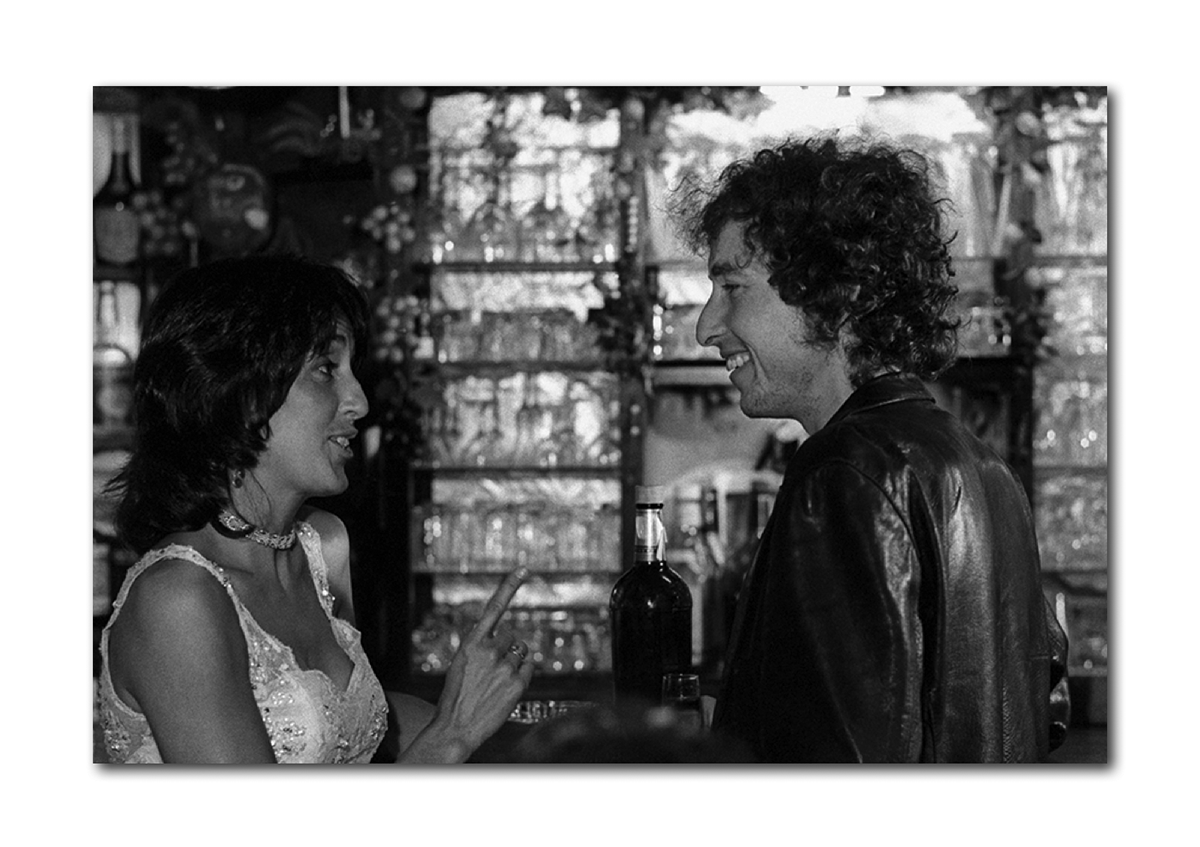
Joan Baez and Bob Dylan, Mama Frasca's Dream Away Lodge, Rolling Thunder Revue party, Nov. 1975. Ken Regan photo.
Joan Baez and Bob Dylan, Mama Frasca’s Dream Away Lodge, Rolling Thunder Revue party, Nov. 1975. Ken Regan photo.

Dylan and his traveling circus enjoy a rare day off in the Berkshire woods, between a double-header the previous day in Springfield and a show the next day in Vermont. They have the run of Mama Frasca’s Dream Away Lodge in Becket, which happens to be a favorite haunt of Arlo Guthrie, who lives nearby and who had been invited to join the troupe for the Springfield shows.

In Moby-Dick, Captain Ahab is nearly blissed out – “as the morning of the third day dawned fair and fresh.”

“Here’s food for thought, had Ahab time to think; but Ahab never thinks; he only feels, feels, feels; THAT’S tingling enough for mortal man! to think’s audacity. God only has that right and privilege. Thinking is, or ought to be, a coolness and a calmness; and our poor hearts throb, and our poor brains beat too much for that.”

The decidedly unschooled Bob Dylan also is near bliss, a decade and a half since he weighed the anchor of his mind in the shallow harbor of Hibbing, Minnesota, now early in the most storied tour in the annals of American popular music.

I attended the Springfield shows, and about twenty years later, I became friends with a guy who had been both neighbor and friend of Mama Frasca.** Not only did he attend the all-day party, but he was with Mama Frasca when Arlo called to make arrangements for the party.

Apparently, the name of Joan Baez came up during the conversation, because as my friend tells the story, when Mama Frasca hung up the phone, she was overcome with joy, “Joan Baez is coming, Joan Baez is coming.” So profound was Mama’s affection for the counter-culture chanteuse that, when she arrived decked-out in dungaree, Mama whisked her upstairs and gave her a pretty white dress to put on.

With the party in full-swing throughout the lodge and environs, Dylan and Baez have a moment alone together at the bar. The former lovers chide each other on their recent marriages:

“It really displeases me that you ran off and got married.”

“You got married first and didn’t tell me.”

“Yeah, but I married the woman I loved.”

“Yeah, that’s true – and I married the man I thought I loved.”

“See, that’s what thought has to do with it – thought will fuck you up!”

“You’re right, I agree with that.

“It’s heart, it’s not head.”

It is unlikely that Mr. Dylan, in the hemisemidemiquaver that precedes his reply, scanned memory for a stored phrase to use. There is a chance, however, that Revue poet Alan Ginsberg happened to be on Chapter 135 at that moment, as he recited from Moby-Dick all day, delighted to be within a dozen miles of Melville’s Arrowhead home, where the book was written.

My thesis is that great minds think alike – and not infrequently they think about the very nature of thought. For artists such as Melville and Dylan, it’s never enough to become masters of their craft; every sunrise illuminates a new horizon, and new horizons exert a force on them that we ordinary sailors are lucky just to read about.

Dave Read

* Wikipedia page on Like A Rolling Stone, with reference to Kooper; there are many renditions of the story worth searching out on the Internet.

** Interview about the Rolling Thunder Revue party at Mama Frasca’s

The Dylan-Baez dialogue is on Youtube – as if the poem needs facts!

OK

take us all to tulsa

Linked poems kill ignorance.

How ’bout that kid
from the Iron Range,
now wranglin’ us down
to where Woody was born –

to the tearful place
Alabama Creek were made
to call home by errant rulers,
by men crooked as the river.

Bright light shines on Black Wall Street –
bookstores, music shops, juke joints
abound, the town’s never had it so good!
God bless the Song and Dance man’s big stash.

Dave Read

News item.
It was announced in March 2016 that Bob Dylan sold his “archive” to the George Kaiser Family Foundation and the University of Tulsa. Included are some 6,000 manuscripts, recordings, and ephemera that will be open to academic research, while casual Dylan fans also will be served by the project.

  • Page 1
  • Page 2
  • Page 3
  • Go to Next Page »

Primary Sidebar

  • The Lonesome Cohort of Bob Dylan
  • The Sophistry of Modern Bob
  • Bob Dylan and the tyranny of prize
  • The British Invasion
  • American Leviathans
  • OK
  • A Refusal to Mourn the Death, by Indifference, of Bob Dylan’s Significance
  • By Appointment of His Royal Bobness
  • Dylan before market forces…

Categories

  • Berkshires Outdoors
  • Dot Kham
  • Dylan concert reviews
  • Essays
  • H. Ben Creadh
  • In re: Bob Dylan
  • Roll tape
  • Uncategorized

© 1997–2025 Dave Read Library of Congress ISSN: 1524-6701; WordPress by ReadWebco

  • Our other sites ->
  • BerkshireLinks.com
  • CannaBiscuit.org
  • ReadsPoems.com