• Skip to primary navigation
  • Skip to main content
  • Skip to primary sidebar
newberkshire.com logo

newberkshire.com

  • Bob Dylan matters
  • Contact us
  • Home

In re: Bob Dylan

Bob Dylan’s Rolling Thunder Revue party at Mama Frasca’s Dream Away Lodge

Sept. 1998 interview by Dave Read

On November 7, 1975, Bob Dylan and the Rolling Thunder Revue spent the day at the Mama Frasca’s Dream Away Lodge in Becket, MA. They had played two shows the day before at the Springfield Civic Center, with special guest and Berkshire county resident Arlo Guthrie, who turned Dylan on to his friend Mama Frasca’s lodge. (See related: Interview with Arlo Guthrie)

This interview is the account of a friend of Mama Frasca’s who asked us to refer to him as “A.I.I.” (Anonymous Indigeneous Individual). It was conducted by Dave Conlin Read in Lenox, MA in 1998 and was excerpted in Q magazine’s special edition Maximum Bob.

Rolling Thunder Revue tour poster

D.C.R.: How did you come to be involved with MamaFrasca’s Dream Away Lodge?

A.I.I.: Just a Berkshire hillbilly, I was living up there on Becket mountain, and I used to visit the Lodge. It was my social milieu. And I used to help Mama Frasca; she was basically illiterate, and I used to write alot of postcards for her. I’d be sitting with her in the afternoon or evening and she’d tell me what she wanted to tell her friends. We were just good pals, myself and Mama.

(Sample photos from the party: Rolling Thunder: Photographs by Ken Regan. )

D.C.R.: You were invited to the Rolling Thunder Revue party?

A.I.I.: Yes, I was up there when there was a phone call and Mama got very excited. She kept saying, “Joan Baez is coming, Joan Baez is coming.” She didn’t say much about Bob Dylan. So, I was invited to the party the next day. I went up there early in the day, around noontime. A couple of guys from Shenandoah came up there shortly. Arlo Guthrie came up in his Ford pickup, I think it was a ’51 Ford – faded green pickup, maybe it was gray. I remember watching the hawks circling with one of the guys from Shenandoah, on the front steps of the Dreamaway.

And then, after a while, various people started arriving. I remember Dylan coming up in a Winnabago. He had a little sign in one of the side windows, it said “Kemp Fish Co.” I remember the cinematographers coming up in a big red Cadillac convertible. Then I was inside having a beer at the bar, and I guess Bob was having a brandy and talking with Mama. I remember introducing Bob to my friend Bob, saying “Bob, meet Bob”.

When Joan Baez got there, Mama swooped her right upstairs. Joan came in in dungarees, all denim. She went upstairs like that – she came down in a white dress with a white pearl necklass. She went right into the music room and Mama took her over to the big square piano. I think she sang – what’s that song – with a wretch like me? – she sang “Amazing Grace.”

Alot of people started crowding into the music room, and the photographers, the cinematographers, started taking alot of shots of Joan and Mama at the piano. Mama was coming out with these mountain-oracle words-of-wisdom and wit and everybody was sucking it up. Because that was about what she was – she was the Oracle.

Earlier, I remember Dylan leaning over the bar to listen to her – to one thing that she said to Dylan, and he was just hanging on every word she said. She had this big thing about love – “With love you’re like the egg – without love, you’re like the hollow egg, without yolk, all white”. Something like that, she had a way of saying things, you had to be there to hear her.

She was quite a character. She had a little guitar, it was painted lime-green, and she used to like to play when she sat in front of the fireplace. She used to call everybody children or sonny – she’d make you feel like you were a child and she was the adult.

They served the standard dinner – salad, chicken, spaghetti, and Mama’s famous hot potatoes, and coffee and Anisette after. Ginsberg was walkin around with Moby Dick, reading it, reading Moby Dick as he was walking around, because he knew of Melville’s stay in the Berkshires, writing Moby Dick in Pittsfield. And then Dylan was going in and out the window, of the freshly-painted north side of the Dreamaway.

D.C.R.: How did you know it was freshly-painted?

A.I.I.: Because my friend was painting it, who I had introduced to Bob – “Bob, this is Bob”, because Bob lived there. He was the caretaker of the place – the bartender, the dishwasher, and everything else. So the next day Bob, the other Bob, made a little sign that said, “Bob Dylan’s footprints”, with an arrow going to the window where he had been climbing in and out – to get away; to get a breath of fresh air from the packed place.

D.C.R.: How many times did Bob go in and out of the window?

A.I.I.: It was just a little prank – he may have done it only once. But I remeber we had the footprints, and they were there for a while, until it got painted again. I remember singing “Be bop a lula” at the piano – Arlo playing the piano.

Singing that song with Bob and Ramblin’ Jack Elliott and the whole crew there. We all did a good rendition of “Be bop a lula.” I remember Joan seemed like a very genuine, sincere individual, interested in the people at large there – the natives. She just seemed genuinely friendly – just a regular person.

D.C.R.: Did Bob take the initiative with any of the music, did he take the lead?

A.I.I.: Not to my recollection. He was belting out the “Be bop a lula” lyrics, I was right there beside him, singing – he was getting into that. His wife was there, Sara, and she and Ginsberg seemed to be talking quite a bit, I don’t know how much weight that had. And Ronee Blakely was there. I had a nice conversation with her, down by the fish pond, feeding the catfish. They used to eat bread out of your hand. It was kind of like feeding piranas, because they’d all come to the surface as soon as you’d throw a little piece of bread in there – they would swarm around. That was another little gig that Mama had there for people – “Oh go down and feed the fish, here take some bread and feed the fish.”

D.C.R.: How did the party break up?

A.I.I.: I didn’t stay into the night time, I kind of drifted away, went home. I left before Bob and the crew. It was like a poetic moment – a happening – it was living poetry, very memorable.

D.C.R.: How did Mama feel about the party afterwards?

A.I.I.: Well Mama loved all kinds of people, but for some reason, she had a real affinity with Joan Baez. She really loved Joan Baez’ voice, essentially. She thought she had a wonderful, beautiful voice, and that it was a gift. So she was just very, very happy to be Joan Baez’ hostess that day.

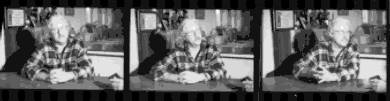
Arlo Guthrie interviewed Nov. 1998 at The Guthrie Center

Nov. 16, 1998 interview by Dave Read.
Arlo Guthrie first came to the Berkshires in the late ’50s to attend the former Indian Hill camp in Strockbridge, where his mother was the dance teacher. His Berkshire roots were further established while he was a student at The Stockbridge School and he became involved with the Berkshire Folk Music Society, then headed by the late Hank Grover, David’s father.

Guthrie recently bought the Kresge Building on North St. in Pittsfield. Besides moving Rising Son Records there, he is looking into the possibility of developing an entertainment center. We visited with Arlo on November 16, 1998 at The Guthrie Center, in the former Episcopal church that his friend Alice Brock used to live in, and where much of Alice’s Restaurant was filmed.

Arlo Guthrie interview with Dave Conlin Read at the Guthrie Center, Nov. 1998.

“I’ve been trying to get something going in downtown Pittsfield for 25 years. I was interested in the old Palace Theater, or even the Capitol before they turned it into the Senior Center. None of that ever panned out because nobody had a clue as to the value of live entertainment.”

Relating the results of a recent study, commissioned by the city of Pittsfield, that stresses how important providing live entertainment is to the revitalization of downtown, Guthrie continued,

“We want to see if we can be a part of that process. We bought the building and we’re hoping that we can make a go of it. I want to develop a nightclub facility, maybe with a little food, but not a big-time restaurant. What I really know is not the restaurant business, it’s the nightclub/theater business.”

Arlo Guthrie photo proofs

After talking about the various “cultural centers” and “tourist destinations” of Berkshires, Arlo continued,

“I see no reason why Pittsfield can’t become a part of all that, even add something to it and tie together all the different crowds. This is a beautiful part of the world, every part of it. We’ve been let down by the major industries. The only big industry that keeps growing is our cultural industry, so I’m anxious to see if we can all benefit from that.”

The legacy of The Music Inn figures prominently in Guthrie’s motivation to extend his commitment to the Berkshires. His father Woody played the very first show there and Arlo played the last, exactly 25 years to the day later.

“The thing we do in Pittsfield will be the closest that we can get to re-doing the kind of music that we had at The Music Inn. It’ll be a big enough club to bring in some of the same kinds of people – maybe the same people. With the help of the City of Pittsfield, I think we can make that happen. We also want a place for young people to go; we’re thinking of establishing a kind of folklore center there.”

“It’s not something I have to do business-wise; I’ve got enough going on to keep me busy for a long time. However, one of the things I’d like to do is spend less time on the road. I’m on the road ten months a year, and I miss the Berkshires. I love it here and I think that we have an obligation to try and retain the best part of who we are for future generations.”

Where did the name “Arlo” come from?

“When my mom was growing up, there was a series of children’s books, called “Arlo Books”, about a little Swiss kid named ‘Arlo’. They were in all the primary schools on the East coast, and she drew a picture for a class project of this kid. And my mom was one of these packrats who saved everything – every ticket stub of every place she had ever been to. She was incredibly organized.

“While she was pregnant with me, walking down the beach one day with my dad, she suddenly realized that the picture she had drawn of this kid ‘Arlo’, in the fifth or sixth grade, looked exactly like my father. He was wearing the same clothes, the same kind of striped shirt, walking on the same kind of beach. And so she went back and found this old picture, and sure enough, she had drawn my dad.

“So they decided that that was an auspicious sign, and that they were going to name me after the kid. But they didn’t know if I would go for a name as awkward as that, so they gave me the middle name ‘Davy’. So I was named after Davy Crockett. She figured he was a popular figure, sort of a rugged, mountain guy, and if I didn’t like the name ‘Arlo’ – which, she wasn’t sure what that was gonna do to me – that I could always call myself ‘Davy’. So I was named ‘Arlo Davy Guthrie.’

Mama Frasca’s Dream Away Lodge

“I had been going to the Dream Away for years, I knew Mama Frasca real well – she was a terriffic, wonderful, crazy, wild woman. I really loved her and used to bring the kids up to her place every weekend. I actually did some recording with her at the old Shaggy Dog studio in Stockbridge. We did a great record there – all these great songs with this old gal. She made a single, and one song was called something like, “God and Mama”.

“So after we did the Rolling Thunder Revue in Springfield (November 6, 1975), I tought it would be fun to take everybody up there. We came up with Bob Dylan, Joan Baez, Allen Ginsberg, Bobby Neuwirth and Ramblin Jack Elliott. They just loved it there; we were fooling around with Mama Frasca, and it became a part of the film, “Renaldo And Clara”.

(For details of the party: Bob Dylan’s Rolling Thunder Revue party at Mama Frasca’s Dream Away Lodge.)

Dave Van Ronk interview, Jan. 21, 1999

By Dave Read; conducted January 21, 1999

Dave Van Ronk Eighth Step Coffeehouse Jan. 1999
We spoke with Dave Van Ronk the day before he was to perform at the Eighth Step Coffeehouse in Albany, NY. After congratulating him on receiving ASCAP’S Lifetime Achievement Award, we mentioned that Ramblin’ Jack Elliott had been honored recently at the White House. Typically, Dave was ready with an anecdote:

“Yeah, at the reception he tried to convince Clinton to sneak off and come with him to a Dylan concert. Bobby was in DC giving a concert that night, and Jack was trying to get Clinton to ditch his secret service and come with him to the concert.”

the importance of teaching to Dave Van Ronk

You give the lie to the adage that “Those who can, do; those who can’t, teach.” You’ve been a teacher your entire career; how has teaching affected your career as an artist?

“You can’t teach without learning. The first thing you have to do when you start teaching is to organize what you know. In the course of organizing what you know into a coherent body, you discover that you know alot more than you thought you thought you did.

“Also, you discover gaps and holes which you can set about filling. So, in systematizing what you’ve picked up here and there and in fragmented ways – incorporating it into a coherent whole – you learn a great deal.

“And students are a stimulus. I’ve had students sort of gang up on me, and get me to work out this or that or the other piece, pieces I wouldn’t have done. And in one or two cases, things have subsequently become mainstays of my repertoire.

“For example, the Entertainer – the classic rag, which I was just reviewing with a student this week. Much more than just a useful performance piece, as it turned out, it became a seminal piece in learning more and more about how to play guitar in drop-D-tuning.

“In terms of spinoffs, that led to possibly ten or fifteen different arrangements. And that was because 2 or 3 of my students wanted to learn how to play the piece. Initially, I didn’t want to work that out – it seemed to me like a great deal of work for a very, very small gain. I was wrong. Things like that are constantly happening.”

Dave Van Ronk moved from jazz to blues

You began your career as a jazz musician; how did your move to the folk scene come about?

“My committment to jazz also led, on the side, to listen to country blues. And since I was already playin the guitar – I had a guitar in my hand – I wanted to figure out how people like john Hurt and Lemon Jefferson did what they did. To begin with, it was a side-line. Most of what I was actively performing was working in the rhythm section of a traditional jazz band.”

“As the folk music revival gained momentum in the mid-50s, my emphasis gradually shifted, so that by 54-55 or 55-56, I was primarily working as a solo entertainer.”
Dave’s musical education

Would you call yourself self-taught?

“To a certain extent. I studied jazz guitar with a man named Jack Norton in Queens in the early 50s. I learned a great deal from him. Then in the mid-50s I met Rev. Gary Davis, although at that point I had learned to finger-pick, sort-of, with an assist from Tom Paley. So I could do some finger-picking already when I met Gary Davis, and I learned a great deal from him, too.”

His brilliant songwriting in addition to his great muicianship?

“Very much so.”

Cocaine Blues, Rev. Gary Davis, Jackson Browne

At a recent Tanglewood concert, Jackson Browne talked about Rev. Gary Davis.

“Jackson recorded Cocaine Blues and he thought it was mine when he learned it. Eight months after he recorded it, he came down to catch me at aclub in Los Angeles. He came back to the dressing room and he said, “You know, I recorded that song of your’s “Cocaine Blues,” and I’d like to know where do I send the royalties?”

“So I said, ‘What you do, is you send them to Rev. Gary Davis’ estate and you get out of here, unless you want to see a grown man cry.'”

Dave Van Ronk’s advice to a young musician today

If you were to addressing the young up-and-coming singer/songwriter, What would you say to someone who wants to go on to have a 50 year career?

“The way you have a career is by doing it – you just have to keep on performing, any possible pretext. The main problem people have now is there are so many performers, and so few places to work it’s very hard to It takes a very long time for a performer to get enough stage experience to be knowledgeable about stagecraft.

“That’s the one thing you can’t practice at home; you can practice singing and you an practice the guitar all by yourself. But the only way you can practice stagecraft is on the stage witha n audience.

“It takes a long time the way things are set up currently for a young performer to get that experience. So the main thing that you have to do is to find every possible excuse to get on that stage.

Dave Van Ronk recommends the Harry Smith Anthology of American Folk Music

What record would you recommend to someone wanting to learn folk music?

The Harry Smith Anthology of American Folk Music“The Harry Smith anthology, that’s where you start, there is no better collection of American traditional music anywhere. It cost a lot but there’s alot of music too – 80 or 90 cuts on that anthology. Familiarity with that will take you a long way.”

Leave a Comment

  • « Go to Previous Page
  • Page 1
  • Page 2
  • Page 3

Primary Sidebar

  • The Lonesome Cohort of Bob Dylan
  • The Sophistry of Modern Bob
  • Bob Dylan and the tyranny of prize
  • The British Invasion
  • American Leviathans
  • OK
  • A Refusal to Mourn the Death, by Indifference, of Bob Dylan’s Significance
  • By Appointment of His Royal Bobness
  • Dylan before market forces…

Categories

  • Berkshires Outdoors
  • Dot Kham
  • Dylan concert reviews
  • Essays
  • H. Ben Creadh
  • In re: Bob Dylan
  • Roll tape
  • Uncategorized

© 1997–2025 Dave Read Library of Congress ISSN: 1524-6701; WordPress by ReadWebco

  • Our other sites ->
  • BerkshireLinks.com
  • CannaBiscuit.org
  • ReadsPoems.com